 AI Tutor
Search for artificial intelligence professionals and you will find three different kinds of page. Some describe jobs like AI engineer or machine learning engineer. Some sell a certificate called Certified Artificial Intelligence Professional or AI Professional. And some use the phrase for ordinary working people, such as marketers and analysts, who now use AI tools every day. All three are using the words correctly. They just mean different people.
This guide separates the three meanings, so you can find the one that fits you. For each kind of AI professional, you will see the typical roles, the core skills and how to show them to an employer. We also look at what builders actually do with a small tested example: how a model is trained, tested on rows it has never seen and checked for overfitting. And because the certificate meaning matters to many readers, we summarise what one example certificate, the PECB Certified Artificial Intelligence Professional, says about itself on its official pages.
A note on honesty. AI job titles are not standard, salaries on many pages are given without a country or a year and tools change every few months. So we do not quote salaries, we say when a fact was read and we tell you what to check yourself. If you are new to the field, our beginner guide to ChatGPT (link when live) is a gentle first step, and our Python practice guide (link when live) helps with the coding side.
What is an AI Professional?
An AI professional is a person whose work involves designing, running, governing or using artificial intelligence systems. There is no single official definition and no protected job title. Companies use the words differently and the same job may be called AI engineer in one company and machine learning engineer in another. So while applying for job, read the description carefully, not just the title.
What the work has in common is that AI systems learn patterns from data and people have to decide what data to use, how to test the result, how far to trust it and what to do when it is wrong. That last part is where human skill still matters.
Three Types of AI Professional
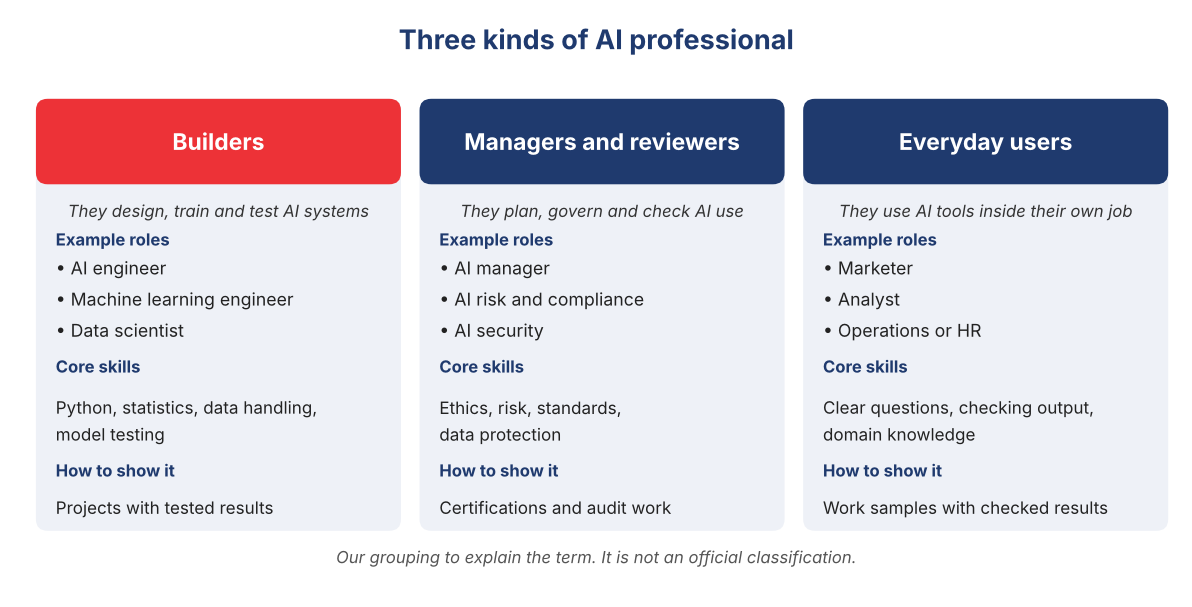
The types above is ours expert grouping, which is made to explain the term. It is not an official classification and real jobs often mix two groups.
| Kind | What they do | Typical background | Where to start |
|---|---|---|---|
| Builders | Design, train, test and deploy AI and machine learning systems | Programming, statistics, data handling | Python, data handling with pandas, one machine learning library, small projects with tested results |
| Managers and reviewers | Plan AI projects, manage risk, security, ethics and compliance | Project, risk, audit, legal, security or IT management | AI basics, data protection rules, risk frameworks, a recognised certificate if your employer values it |
| Everyday users | Use AI tools inside their own job to work faster and better | Any profession: marketing, finance, HR, operations, teaching | Daily practice with an AI assistant on real work, and the habit of checking every output |
Builder Roles Compared
These titles overlap and employers use them loosely. The table shows the usual difference in focus.
| Role | Main focus | Typical work |
|---|---|---|
| AI engineer | Building applications that use AI models, including generative AI | Connecting models to products, testing, deploying, monitoring |
| Machine learning engineer | Training and running machine learning models at scale | Data pipelines, model training, deployment, performance |
| Data scientist | Finding patterns and building predictive models from data | Analysis, statistics, modelling, explaining results to business teams |
| AI research scientist | Creating new methods and algorithms | Experiments and papers. Often needs advanced study |
If you are weighing a data science route, our data mining guide (link when live) shows where analysis ends and modelling begins, and the machine learning interview questions page on prwatech.in covers the questions these roles face.
What a Builder Does: A Tested Example
Most pictures of AI work show a model learning something clever. Most of the real work is different: getting the data ready, deciding how to test, and checking that a result is honest. The example below is small, but it follows the steps a builder follows. It uses the wine data set that comes with the scikit learn library: 178 wines, 13 chemical measurements each, and 3 classes of wine. The file is ai_builder_demo.py, sent with this post. We ran it on Python 3.13 with scikit learn 1.9, and everything below is its real output.
Step 1: Look at the data and split it
We keep 45 rows aside as a test set. The model never sees them during training. This is the most important habit in the field. A model tested on its own training data usually looks good.
Step 2: Set a baseline
A baseline is the score of a model that does almost nothing. Here it always guesses the most common class. The test set has 18 rows of that class out of 45, which is 40 percent. A real model must beat this by a good margin, or it adds nothing. Many weak projects skip this step.
Step 3: Train a model and test it
The model got all 45 test rows right. The confusion matrix shows each true class on a row and the predicted class in a column, so numbers on the diagonal are correct answers: 15 plus 18 plus 12 is 45. But be careful. A perfect score on only 45 rows can be partly luck, and this data set is a clean teaching example. Real data is messier and scores are lower.
Step 4: Check for overfitting
A decision tree with no limit memorised the training rows (100 percent) but scored 88.9 percent on new rows. That gap is overfitting. Limiting the tree to depth 2 made the gap smaller, but the tree is now too simple and scores only 75.6 percent on the test rows. Good model building means finding the middle, and it needs testing, not guessing.
Step 5: Test more than once
Cross validation splits the data five ways and tests five times. The mean is 98.3 percent, with scores from 97.1 to 100. This is a steadier estimate than one split of 45 rows, and it is the number we would report. The script checks the row counts and that the model beats the baseline by a clear margin, and ends with “All checks passed”.
What this example does not show: collecting data, cleaning it, deploying the model, watching it after launch, and explaining it to people who do not code. Those take most of a real project.
The Certificate Meaning: Certified Artificial Intelligence Professional
Some readers who search for an AI professional want a certificate. Several organisations use names like AI Professional. We read the official pages of one example, PECB, on 4 November 2026. Please treat the details below as a snapshot and check the PECB pages before you decide, because course terms change.
| Item | What the PECB pages say |
|---|---|
| Name | PECB Certified Artificial Intelligence Professional (CAIP) |
| Who it is for | The page lists eight groups, including AI practitioners, data scientists, IT managers, risk and compliance officers and executives |
| Course length | 5 days. Days 1 to 4 cover the content and day 5 is the exam |
| Exam domains | AI fundamentals, data analysis and visualization, machine learning models, deep learning and NLP, computer vision and robotics, AI security, and AI ethics, governance and strategy |
| Recommended background | A general understanding of basic programming knowledge is recommended for the course |
| Credential levels | A provisional credential needs the exam and the PECB Code of Ethics. As we read it, the full credential also lists two years of AI experience within five years and 300 hours of project experience |
| Fee | No price on the page. It says certification and examination fees are included in the price of the training course |
| Retake | One free retake of the exam within 12 months of the first exam date |
| Validity and renewal | Not stated on the pages we read |
| Other | 31 CPD credits for attendees. Labs run in a web browser |
A certificate shows that you completed a course and passed an exam. It does not show that you can build or govern an AI system, so pair it with real work or projects.
The Everyday User Meaning
Some people use the phrase AI professional or AI native professional for anyone who uses AI daily in their job, whatever the job. One training company defines the AI native professional as someone who uses AI every day for planning, doing and solving problems, and says it is a way of working and not a job title. That definition comes from the publisher and not from a standards body, but the skills it names are sensible.
- Ask clear questions. A vague request gets a vague answer. Say who the answer is for, what you need and in what format.
- Check what you get. AI tools can sound sure and be wrong. Check facts, numbers and sources before you use anything.
- Know the limits. Do not paste private customer data or company secrets into a tool unless your company rules allow it.
- Add your own knowledge. The value comes from combining the tool with what you know about your work.
- Present the result well. Edit the output into your own words and format.
The practice is simple: use an AI assistant on real tasks for a few weeks, keep notes on what worked and what failed, and build a small collection of prompts and checks for your own work. Our ChatGPT tutorial for beginners (link when live) gives a first set of steps. Prwatech also runs free GPT classes, but the full AI course is not free. For details, ask the Prwatech learning team.
Skills You Need to Become a AI Professional
| Skill | Builders | Managers and reviewers | Everyday users |
|---|---|---|---|
| Python and data handling | Core | Helpful | Optional |
| Statistics and testing ideas | Core | Helpful | Basic |
| Machine learning libraries | Core | Understand the ideas | Not needed |
| Data protection, risk and ethics | Know the basics | Core | Know the basics |
| Clear writing and questions | Important | Important | Core |
| Checking and verifying output | Core | Core | Core |
| Knowledge of your own field | Helpful | Core | Core |
The table is our judgement of the usual emphasis, not a standard. The one row that is core for everyone is checking output. This is also why the test set and baseline matter so much for builders.
How to Become an AI Professional?
| If you are | A sensible first step | Then |
|---|---|---|
| A student or fresher | Learn Python and basic statistics | Build three small projects with held out tests, like the example above, and write each one up |
| A software developer | Learn data handling and one machine learning library | Add a small project that connects a model to an application, with tests |
| A data analyst | Learn Python machine learning basics on top of SQL and statistics | Move from reports toward models, using a real data set from your own work |
| A working professional in another field | Use an AI assistant daily on real tasks and keep notes on checking | Decide whether to deepen toward building or toward managing AI use in your field |
| A manager, auditor or compliance officer | Learn AI basics and data protection rules | Look at recognised certificates if your employer values them, and ask what they cover |
If you want guided practice, Prwatech runs a AI certification course, Python certification course and a Data Science course. Offline classes are held in Bangalore (BTM Layout) and Pune (Kharadi). Learners in other cities can join live online classes or study at their own pace. For the syllabus, batch dates and fees, please ask the Prwatech learning team through the demo class form below.
