 AI Tutor
If you work with Spark, data pipelines or machine learning on the cloud, sooner or later someone will ask whether you have a Databricks certificate. Then the confusion starts. There are many exams, with names that sound alike. Some guides list fees and exam formats that no longer match the official pages. And a second family of exams, from Microsoft, uses the words Azure Databricks in the title.
This guide lists the Databricks certifications as they appear on the official Databricks pages we read on 27 October 2026 with the number of questions, time limit, fee, validity and the exam sections with their weights. It also covers the Azure Databricks certification from Microsoft, which is a different exam from a different company. Then it helps you pick one by role, shows where the marks are for two popular exams and gives you six practice tasks on Spark exam topics. We ran the code and show the real output.
One warning first. Exam details change. Names, fees, section weights and even the exam list are updated by Databricks and Microsoft from time to time. We checked the official pages on the date above and one popular guide we reviewed still carried older fees and formats, so use this post to understand the landscape and then confirm every number on the official exam page before you pay.
Databricks Certifications at a Glance
Databricks lists certification exams in several tracks: data analyst, data engineer, machine learning engineer, generative AI engineer, context engineer and Apache Spark developer. Each track has an associate level and the data engineer and machine learning tracks also have a professional level. There are also free accreditations and badges, which are different from certifications. The table shows the exams whose pages we read in full.
| Exam | Level | Scored questions | Time | Recommended experience |
|---|---|---|---|---|
| Data Analyst Associate | Associate | 45 | 90 minutes | 6 months or more of hands on data analysis |
| Data Engineer Associate | Associate | 45 | 90 minutes | Hands on experience with the tasks in the exam guide |
| Data Engineer Professional | Professional | 59 | 120 minutes | Hands on experience with the tasks in the exam guide |
| Machine Learning Associate | Associate | 48 | 90 minutes | 6 months or more of hands on work |
| Machine Learning Professional | Professional | 59 | 120 minutes | 1 year or more of hands on work |
| Generative AI Engineer Associate | Associate | 45 | 90 minutes | 6 months or more of hands on generative AI work |
| Associate Developer for Apache Spark | Associate | 45 | 90 minutes | 6 months or more of hands on work. Code is in Python only |
The landing page also lists an Associate Context Engineer exam and a renewal exam for the Data Engineer Associate. We did not read their pages, so check them directly if they interest you. Platform Architect assessments for AWS, Azure and GCP, a Platform Administrator accreditation and Analytics Fundamentals are listed as well. The Databricks Certified Hadoop Migration Architect exam is retired. The page says it was no longer available from 1 August 2024. If an older guide still lists it, that guide is out of date.
Rules That Apply to Every Databricks Exam
| Topic | What the official pages say |
|---|---|
| Fee | USD 200 per attempt for every exam we checked. The fee on the exam pages is in US dollars, so what you pay in rupees depends on the exchange rate and any taxes |
| Validity | Two years from the date awarded |
| Recertification | Take the full current version of the exam again. There is no short update path, except that a renewal exam is listed for the Data Engineer Associate |
| Retakes | You can retake as often as you like, but you must wait 14 days between attempts and pay the full fee each time. No free retake vouchers |
| Format | Multiple choice. No test aids allowed. The exam includes some unscored questions, and extra time is built in |
| Delivery | Online proctored or at a test centre, through Kryterion |
| Prerequisites | None required. Related training is recommended |
| Passing score | Not published. Databricks sets and can change it |
| Results | An unofficial result appears at the end of the exam. For a pass, Databricks reviews the proctor recording first, then emails a digital badge through Accredible |
| Practice exams | The FAQ says none are offered |
| Minimum age | 18 years |
The FAQ page we read was last modified in May 2025, so treat it as a guide and let each exam page override it. In particular, the FAQ describes exam lengths of 90 to 120 minutes and 45 to 60 scored questions, which matches the exam pages we read, apart from the Machine Learning Associate at 48 questions and the two professional exams at 59.
The Databricks Exams in Detail
Data Engineer Associate
This exam suits people who build pipelines on the Databricks platform. Code is shown in SQL where possible and in Python otherwise. It is offered in English, Japanese, Portuguese (Brazil) and Korean. Sections: Databricks Intelligence Platform 6 percent, Data Ingestion and Loading 21, Data Transformation and Modeling 22, Working with Lakeflow Jobs 16, Implementing CI and CD 10, Troubleshooting, Monitoring and Optimization 10, and Governance and Security 15.
Data Engineer Professional
A deeper exam with 59 scored questions in 120 minutes. The largest section is developing code for data processing with Python and SQL at 22 percent, followed by cost and performance optimisation at 13 percent. Then come data transformation, cleansing and quality, monitoring and alerting, ensuring data security and compliance, and debugging and deploying, at 10 percent each. Data ingestion and acquisition and data governance are 7 percent each. Data modelling is 6 percent and data sharing and federation is 5 percent. There is no required associate exam, though the associate level is a sensible first step for most people.
Data Analyst Associate
For people who work in Databricks SQL, dashboards and AI and BI Genie spaces. Sections: executing queries using Databricks SQL and SQL Warehouses 20 percent, creating dashboards and visualizations 16, analyzing queries 15, developing, sharing and maintaining AI and BI Genie spaces 12, understanding the Databricks Data and AI Platform 11, managing data 8, securing data 8, importing data 5 and data modeling with Databricks SQL 5. The exam is in English.
Associate Developer for Apache Spark
This is the exam for Spark skills. The code is in Python only. Sections: DataFrame and Dataset API applications 30 percent, Spark architecture and components 20, using Spark SQL 20, troubleshooting and tuning 10, Structured Streaming 10, using Spark Connect to deploy applications 5, and using the Pandas API on Spark 5. The page does not say which Spark version the exam targets, so check the exam guide before you plan your study. This exam is the closest match to what our PySpark interview questions guide (link when live) covers.
Machine Learning Associate and Professional
The associate exam has 48 scored questions. Sections: Databricks Machine Learning 38 percent, Model Development 31, ML Workflows 19 and Model Deployment 12. ML code is in Python. The professional exam has 59 scored questions in 120 minutes, with Model Development 44 percent, ML Ops 44 and Model Deployment 12. It does not require the associate exam.
Generative AI Engineer Associate
Sections: Application Development 30 percent, Assembling and Deploying Apps 22, Design Applications 14, Data Preparation 14, Evaluation and Monitoring 12 and Governance 8. This is a newer area, and exam content may change quickly, so read the current exam guide.
The Azure Databricks Certification From Microsoft
People who search for the Azure Databricks certification are often looking for Microsoft’s exam. Microsoft Learn lists Microsoft Certified: Azure Databricks Data Engineer Associate, which you earn by passing exam DP-750, Implementing Data Engineering Solutions Using Azure Databricks. It is issued by Microsoft and booked through Pearson VUE. The Databricks exams above are issued by Databricks. They are different credentials with different exam rules.
| Item | DP-750 details from Microsoft Learn |
|---|---|
| Level and role | Intermediate, data engineer |
| Duration | 120 minutes, proctored. Interactive components are possible |
| Passing score | 700 or greater |
| Skills measured | Prepare and process data 30 to 35 percent, deploy and maintain data pipelines and workloads 30 to 35, set up and configure an Azure Databricks environment 15 to 20, secure and govern Unity Catalog objects 15 to 20 |
| Candidate profile | Skills in SQL and Python, Unity Catalog data quality and governance, Git and software development lifecycle practices, and familiarity with Microsoft Entra, Azure Data Factory and Azure Monitor |
| Retake | You can retake after 24 hours. The wait for later attempts varies |
| Price | Not on the page we read. Microsoft says the price depends on the country or region where the exam is taken. Check the Pearson VUE booking page |
| Validity and renewal | Not stated on the pages we read. Check Microsoft Learn |
Which one should you choose? If your company uses Azure and wants a Microsoft credential, DP-750 fits. If you want a credential issued by Databricks itself, the Databricks exams are the natural choice. You can take both. This is a judgement call, and we did not find an official statement that ranks them. See also our guides on the AWS certification path and the GCP certification path if you are comparing cloud tracks.
Which Certification Should You Take
| Your role or goal | Start with | Why |
|---|---|---|
| Student or fresher who knows Python and Spark basics | Associate Developer for Apache Spark | Tests core Spark skills in Python, and most of the topics are free to practise on your own computer |
| Data engineer working on Databricks | Data Engineer Associate, then Professional | The associate covers ingestion, transformation, Lakeflow jobs and governance |
| SQL analyst or BI developer | Data Analyst Associate | Focused on Databricks SQL, dashboards and Genie spaces |
| Data scientist | Machine Learning Associate, then Professional | Covers Databricks ML tools, model development and deployment |
| Building AI applications | Generative AI Engineer Associate | Application design, evaluation and governance |
| Azure data engineer | DP-750 from Microsoft, and optionally a Databricks exam | Matches the Azure and Unity Catalog skills Microsoft lists |
A sensible rule: choose the exam that matches the work you do or want to do next, not the one that sounds the most advanced. The recommended experience is six months of hands on work for the associate exams, and that matters. Passing a multiple choice exam with only theory is possible for some people, but it does not give you the skills an employer will test in an interview.
Where the Marks are? Exam Weights
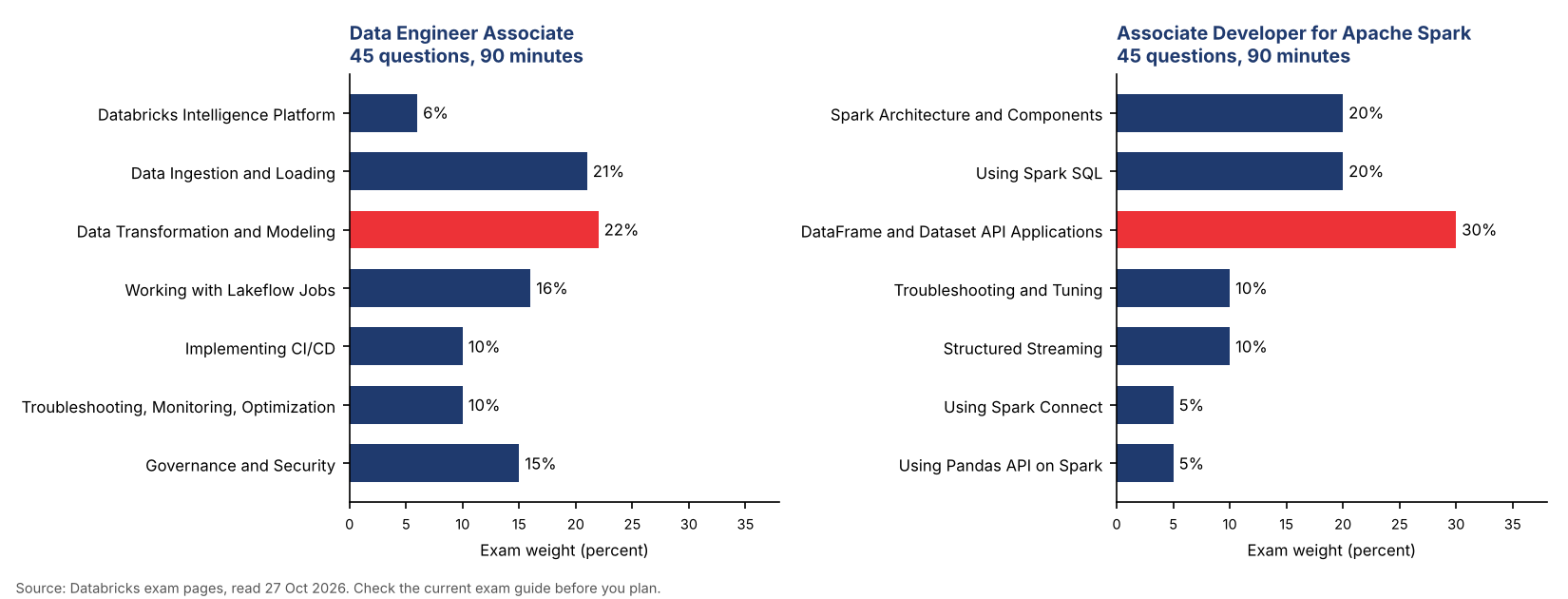
The charts show why the exam guide matters. In the Spark exam, the DataFrame API alone is 30 percent, and DataFrame API, Spark SQL and Spark architecture together are 70 percent. In the Data Engineer Associate, transformation and modelling (22 percent) and ingestion (21 percent) lead, but governance and security (15 percent) and Lakeflow jobs (16 percent) together are nearly a third. A study plan should follow the weights. If you split your time evenly across sections, you will spend too long on the 5 and 6 percent topics.
A rough way to plan, and this is our suggestion rather than an official method: multiply the days you can study by each section weight, and keep a small share of time for mixed practice and review. If you have 30 study days for the Spark exam, the DataFrame API gets about 9 days, and Spark Connect and the Pandas API on Spark get about 1 or 2 days each.
Practice Tasks for Spark Exam Topics
The tasks below follow topics in the Spark developer exam guide: the DataFrame API, Spark SQL, partitions, joins, window functions and the Pandas API on Spark. They are practice material we wrote, not official sample questions, and the Databricks FAQ we read says it offers no practice exams. The file spark_exam_practice.py runs on your own computer in local mode. We ran it with PySpark 4.2.0. Every result below is its real output, and the file ends with checks that pass.
Tasks 1 and 2: the same answer in the DataFrame API and in Spark SQL
The SQL query prints the same table as above.
Check by hand: North is 4 x 250 + 2 x 400 + 2 x 900 = 3,600. The exam expects you to read and write both styles, so practise translating between them. The script asserts that the two results are identical.
Task 3: lazy evaluation and partitions
A filter is a transformation, so it returns a new DataFrame and does no work. The count is an action, so it runs the job. Orders with quantity above 2 are orders 1, 3, 5 and 6, which is 4 rows. Questions on transformations versus actions, and on repartition versus coalesce, are common in Spark exams.
Task 4: joins
Three products have orders but only two are in the second table. Mat has 3 orders and Sheet has 3, so the inner join gives 6 rows. The left join keeps all 8 orders. The left anti join returns only the 2 Belt orders that have no match.
Task 5: window function
This returns the biggest order in each region. For East, order 6 is 5 x 400 = 2,000. For South, order 3 is 6 x 250 = 1,500. Learn how a window differs from a group by: the window keeps every row and adds a rank column.
Task 6: the Pandas API on Spark
This needs pandas and pyarrow installed. PySpark 4.2.0 printed a warning that it does not yet fully support pandas 3, which is what we had installed, though this task ran correctly. If it fails for you, install a pandas version below 3.
One honest limit: the Data Engineer Associate focuses on the Databricks platform itself, including Lakeflow jobs, governance and Delta tables. You cannot practise those properly in local mode, so you will need a Databricks workspace. Check Databricks for its current free or trial options before you assume any cost.
How to Prepare and is It Worth It?
- Read the exam guide first. Every exam page links to one, and it is the source of truth for topics and weights.
- Match your study time to the weights, as in the charts above.
- Do real work on the platform. The recommended six months of hands on experience is there for a reason.
- Do not rely on memory dumps. They are often wrong or out of date, and using leaked exam content can break the exam rules. The FAQ says no practice exams are offered, so make your own tasks like the ones above.
- Book a slot only when you are scoring well on your own practice. A failed attempt costs the full fee again and a 14 day wait.
- Check your equipment for online proctoring. The FAQ warns that work computers with firewalls can cause the exam to be suspended.
Is it worth it? A certificate shows that you passed a test of a certain body of knowledge. It does not replace project work, and employers differ in how much they value it. We do not quote salary figures, because the sources we found were unclear about country and year, and certified and non certified pay are not separated. The best way to judge is to look at job listings for the roles you want and see whether they ask for Databricks skills by name.
If you want guided practice in Spark, Prwatech runs a PySpark certification course in Bangalore and a Big Data course in Bangalore. Offline classes are held in Bangalore (BTM Layout) and Pune (Kharadi). Learners in other cities can join live online classes or study at their own pace. For the syllabus, batch dates, fees, and to ask whether the course covers the Databricks exam topics, please ask the Prwatech learning team through the demo class form below.
