Map with Pie Chart
Map with Pie Chart in Power BI
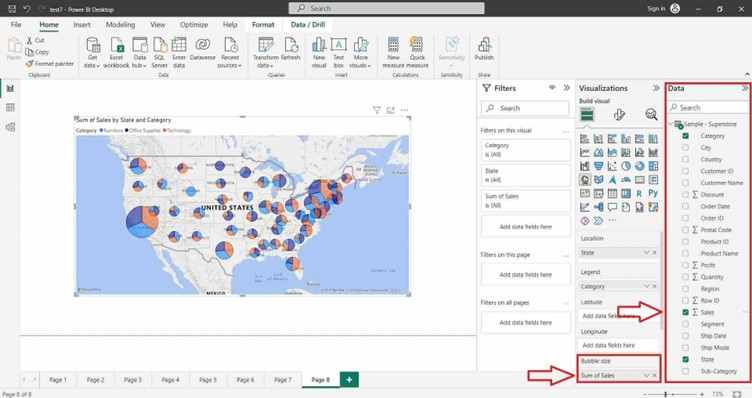
This is Power BI’s Map visual, plotting a bubble at each location in your data, taken a step further. Add a categorical field to Legend, and each bubble stops being a single colored dot and becomes a small pie chart instead, split into slices by category. It is a genuinely useful way to see both where something is happening and what it is made up of, in one visual, without needing a separate chart for the breakdown.
What Actually Turns a Bubble Into a Pie Chart
The two fields do two different jobs, and it helps to know which is which. Legend is what creates the pie slices. The moment you put a categorical field there, such as product type or customer segment, Power BI divides each bubble into slices sized by how much of that category exists at that location. Bubble Size is a separate setting that controls how large the whole pie is at each location, based on a value you choose, such as total sales. You can use Legend on its own and still get pie sliced bubbles. Adding Bubble Size on top just means the pies themselves grow or shrink based on total volume, so a location doing more business shows up as a visibly bigger pie.
Step by Step Process of Creating MAP with Pie Chart in Power BI
Step 1: Add a Map to the Report
In the Visualizations pane, click the Map icon. This adds an empty map visual to the report canvas.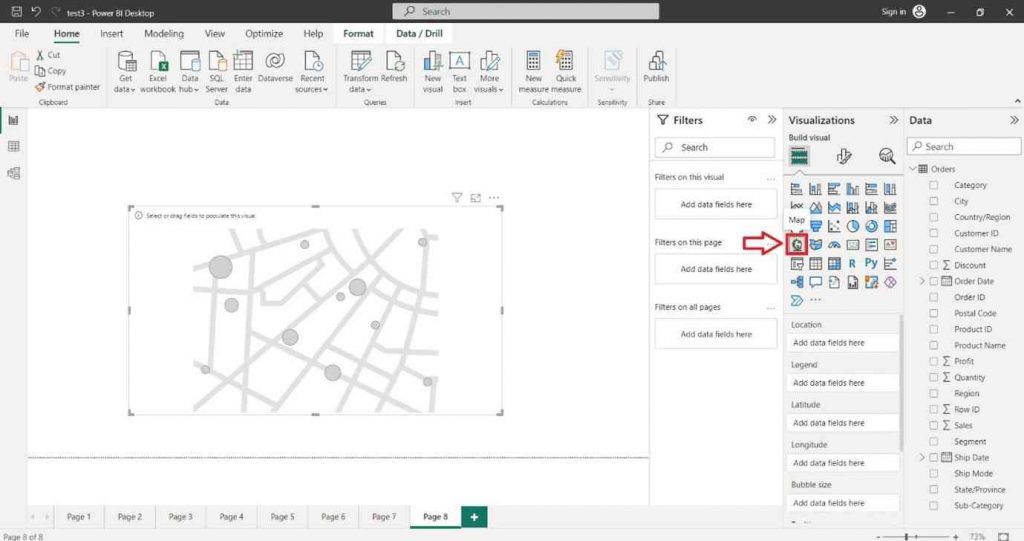
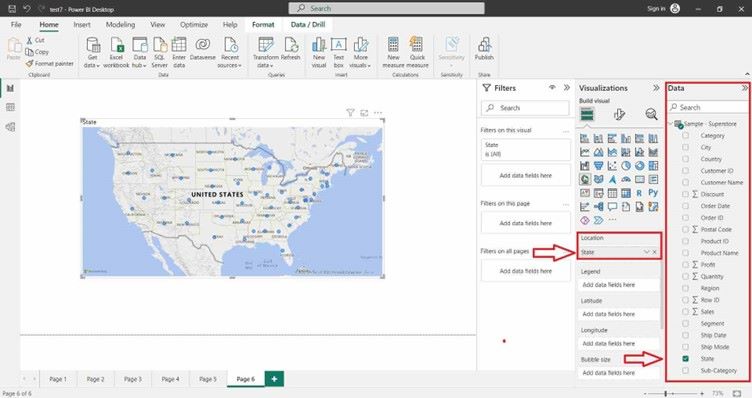
Step 2: Add a Field to Location
Drag your geographic field, such as country, state, or city, into the Location section. This is what places a bubble on the map for each value.
Step 3: Adjust the Overall Bubble Size
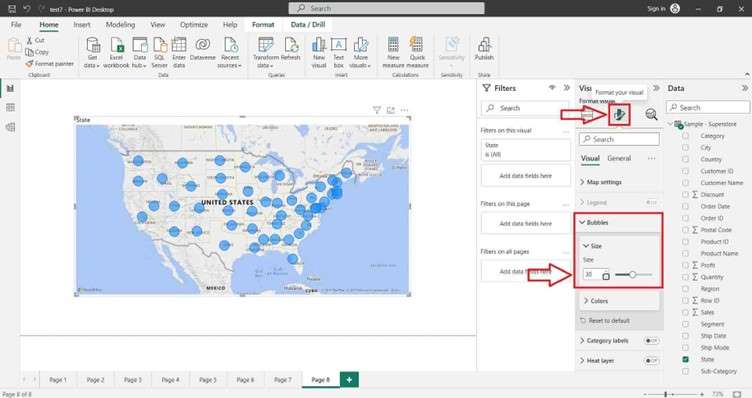
Click the Format icon, then look for Bubbles, and adjust the size setting there. This changes how large or small every bubble appears overall, independent of any field, and it is a setting you can revisit at any point as you add more fields to the chart.
appropriately.
Step 4: Add a Field to Legend
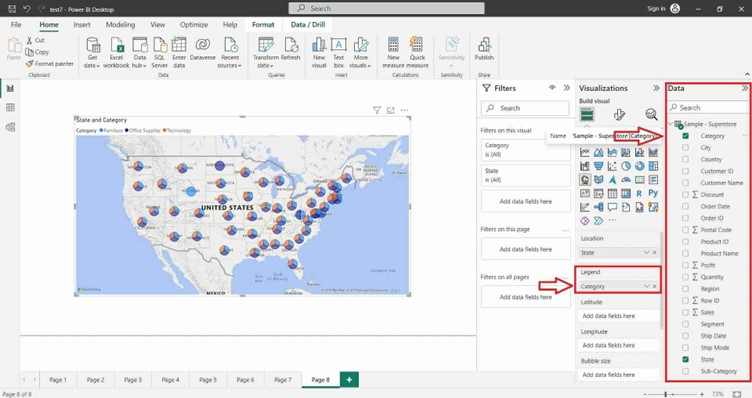
Drag the field you want to split each bubble by, such as product category or customer type, into the Legend section. This is the step that turns plain bubbles into pie charts.
Step 4: Add a Field to Bubble Size
Drag the number you want each pie’s overall size to reflect, such as total sales or total count, into the Bubble Size section. Locations with a higher total will now show up as visibly larger pies.
Known Limits Worth Knowing Before You Build One
- This visual can plot up to about 3,500 data points. Beyond that, Power BI automatically samples your data and only shows a subset, silently, without an error, so a map that looks complete may not actually represent every location in a very large dataset.
- Legend categories are generally capped at around 12 per bubble. If your field has more distinct values than that, some categories may not appear in the pie slices at all. Group minor categories into an Other value if your field has more than this.
- Performance can degrade with a very large number of locations combined with several legend categories, since Power BI is rendering a full pie chart at every single point on the map, not just a dot.
When to Use a Map with Pie Chart
- You have a moderate number of locations, roughly in the dozens to low hundreds, not thousands.
- You have a small number of categories per location, ideally under 6, so each pie stays readable at a glance.
- You genuinely need both the geographic spread and the categorical breakdown in one visual. If you only need one or the other, a plain bubble map or a plain pie chart will be easier to read.
Common Mistakes to Avoid
- Using it with thousands of locations. Past a few hundred, the map gets cluttered and you risk hitting the data point sampling limit without realizing it.
- Splitting by a field with many distinct values. A Legend field with 20 or 30 categories will produce unreadable slivers of pie and may silently drop categories past the display limit.
Forgetting that Legend alone already creates pie slices. If you only wanted colored bubbles, not pie charts, put your categorical field elsewhere and use a numeric measure for color or size instead.
That covers building a map with pie chart bubbles in Power BI, and the limits worth knowing before you rely on it. To keep building out your report with other map types, explore Prwatech’s Power BI training program, which includes placement assistance.