Query DSL Component
Elasticsearch Query DSL: Match, Range, Bool and Filter Queries
Type the word ford in a search box, and you expect cars made by Ford. Add a price limit, and you expect only the cheap ones. Hide the black ones, and prefer the ones with a sunroof. All of that is one search in Elasticsearch, and the way you write it is the Query DSL.
The Query DSL is a language built from JSON. You describe what you want in a query object, and send it to the search API. Each query type does one job. Some find words in text, some compare numbers, some check that a field exists, and the bool query joins them together with and, or and not logic.
This guide goes through the main query types, in the same order as the original page: match_all, match, multi_match, exists, match_phrase, range, sorting, the bool query with must, must_not and should, and filters. The old page showed each one only as a picture. Here, every query has its full text, so you can copy it, and the matching documents are listed so you can check your own result. We also explain query context against filter context, and the term query mistake that catches most beginners.
What is Query DSL in Elasticsearch?
DSL stands for domain specific language. In Elasticsearch, the Query DSL is the set of JSON queries that you put in the query part of a search request. The old page said that searches are done using a query component, and that is the idea. A search request looks like this:
The word cars is the index, _search is the search API, and everything inside query is the Query DSL. The Elastic docs split queries into two kinds of use, which we explain next.
Query Context and Filter Context
This idea explains why Query DSL has both match and filter, so it is worth a minute.
| Aspect | Query context | Filter context |
|---|---|---|
| Question it asks | How well does this document match? | Does this document match, yes or no? |
| Score | Calculates a relevance score, shown in _score | No score |
| Best for | Full text search, where some matches are better than others | Exact values, numbers, dates and statuses |
| Caching | Not cached | Frequently used filters are cached |
| Where it applies | The query parameter, and the must and should clauses of bool | The filter and must_not clauses of bool, and constant_score |
The rule of thumb in the Elastic docs is simple. Use query context when a condition should change the score. Use filter context for everything else.
Set Up Sample Data
To make every example copyable, here is a small index of 10 cars. Run these two requests in Kibana Dev Tools. The make and model fields are text, with a keyword sub field. The description is text. The sunroof field is only present on 4 cars, which we need for the exists example. Refresh makes the documents searchable at once.
| ID | Make | Model | Year | Price | Color | Description |
|---|---|---|---|---|---|---|
| 1 | Toyota | Corolla | 2022 | 21000 | white | Reliable family sedan with low running cost |
| 2 | Toyota | Camry | 2023 | 28000 | black | Comfortable executive sedan with hybrid engine |
| 3 | Toyota | Fortuner | 2021 | 41000 | white | Powerful diesel SUV for rough roads |
| 4 | Toyota | Yaris | 2020 | 14000 | silver | Compact city hatchback easy to park |
| 5 | Honda | City | 2022 | 19000 | silver | Spacious family sedan with good mileage |
| 6 | Honda | Civic | 2023 | 26000 | black | Sporty sedan with turbo engine |
| 7 | Honda | Amaze | 2021 | 12000 | white | Compact sedan for city driving |
| 8 | Ford | Figo | 2020 | 11000 | white | Small city hatchback with low price |
| 9 | Ford | Endeavour | 2022 | 44000 | grey | Powerful diesel SUV with off road ability |
| 10 | BMW | X1 | 2023 | 52000 | black | Premium compact SUV with turbo engine |
Sunroof is set to true on the cars with ID 2, 6, 9 and 10. The other six have no sunroof field at all. In each example below, I list the matching documents. A real response has more fields, such as _id, _score and _source for each hit. When no sort is given, hits come back with the best score first, so the order on your screen may differ from my tables.
1. Match_All Query
The match_all query matches every document in the index. It is the default when you send no query. The old page said that it returns the configurations of the index. That is not right. It returns documents only, and each gets a score of 1.0.
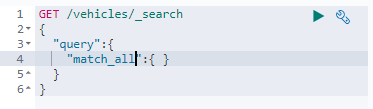
Matching documents:
| ID | Make | Model | Price | Color |
|---|---|---|---|---|
| 1 | Toyota | Corolla | 21000 | white |
| 2 | Toyota | Camry | 28000 | black |
| 3 | Toyota | Fortuner | 41000 | white |
| 4 | Toyota | Yaris | 14000 | silver |
| 5 | Honda | City | 19000 | silver |
| 6 | Honda | Civic | 26000 | black |
| 7 | Honda | Amaze | 12000 | white |
| 8 | Ford | Figo | 11000 | white |
| 9 | Ford | Endeavour | 44000 | grey |
| 10 | BMW | X1 | 52000 | black |
All 10 documents match. Every hit gets a score of 1.0.
If you only want the number of documents, use the count API with the same query. It returns the count and no hits:
2. Match Query
The match query is the standard full text search. Elasticsearch splits your search text into words, lower cases them, and finds documents that have those words in the field. The old page said that the query checks the same field pattern, which does not explain this. Here it finds the Ford cars. Notice that I typed ford in lower case. The make is stored as Ford, but because the field is analysed, the capital letter does not matter.
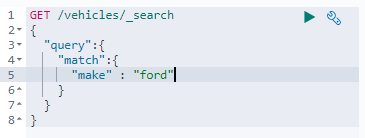
Matching documents:
| ID | Make | Model | Price | Color |
|---|---|---|---|---|
| 8 | Ford | Figo | 11000 | white |
| 9 | Ford | Endeavour | 44000 | grey |
More Than One Word
With more than one word, the match query uses OR by default. A document with any of the words matches, and the one with more words scores higher.
Matching documents:
| ID | Make | Model | Price | Color |
|---|---|---|---|---|
| 1 | Toyota | Corolla | 21000 | white |
| 2 | Toyota | Camry | 28000 | black |
| 5 | Honda | City | 19000 | silver |
| 6 | Honda | Civic | 26000 | black |
| 7 | Honda | Amaze | 12000 | white |
To require all the words, set the operator to and:
Matching documents:
| ID | Make | Model | Price | Color |
|---|---|---|---|---|
| 1 | Toyota | Corolla | 21000 | white |
| 5 | Honda | City | 19000 | silver |
3. Multi_match Query
The multi_match query runs the same search text on several fields. Here it looks for the word city in both the model and the description. Some cars match in the model, and some match in the description.
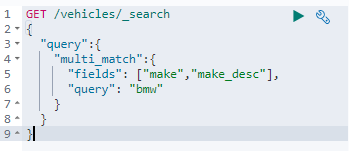
Matching documents:
| ID | Make | Model | Price | Color |
|---|---|---|---|---|
| 4 | Toyota | Yaris | 14000 | silver |
| 5 | Honda | City | 19000 | silver |
| 7 | Honda | Amaze | 12000 | white |
| 8 | Ford | Figo | 11000 | white |
Car 5 matches because its model is City. Cars 4, 7 and 8 match because the word city is in the description.
4. Exists Query
The exists query finds documents that have a value in a field. The old page used it with the count API, which is a good way to answer how many documents have this field. Here it counts the cars that have a sunroof field.
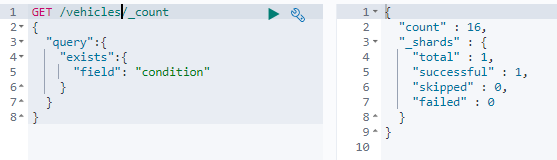
To see the cars themselves, use the search API:
Matching documents:
| ID | Make | Model | Price | Color |
|---|---|---|---|---|
| 2 | Toyota | Camry | 28000 | black |
| 6 | Honda | Civic | 26000 | black |
| 9 | Ford | Endeavour | 44000 | grey |
| 10 | BMW | X1 | 52000 | black |
A field counts as missing when it is not in the document, or when its value is null or an empty list. A value of false still exists.
5. Match_phrase Query
The match_phrase query finds the words together, in the same order. This is different from match, which finds the words anywhere. Here it finds the exact phrase diesel SUV.
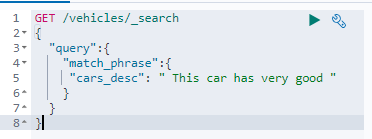
Matching documents:
| ID | Make | Model | Price | Color |
|---|---|---|---|---|
| 3 | Toyota | Fortuner | 41000 | white |
| 9 | Ford | Endeavour | 44000 | grey |
The order of the words matters. The reverse phrase finds nothing:
Matching documents: none.
A plain match query with the same words finds more, because it also finds car 10, which has the word SUV but not the word diesel:
Matching documents:
| ID | Make | Model | Price | Color |
|---|---|---|---|---|
| 3 | Toyota | Fortuner | 41000 | white |
| 9 | Ford | Endeavour | 44000 | grey |
| 10 | BMW | X1 | 52000 | black |
6. Range Query
The range query finds numbers or dates between limits. It uses four operators:
| Operator | Meaning |
|---|---|
| gt | Greater than |
| gte | Greater than or equal to |
| lt | Less than |
| lte | Less than or equal to |
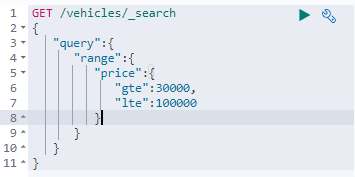
Cars that cost from 20000 to 30000, with both ends included:
Matching documents:
| ID | Make | Model | Price | Color |
|---|---|---|---|---|
| 1 | Toyota | Corolla | 21000 | white |
| 2 | Toyota | Camry | 28000 | black |
| 6 | Honda | Civic | 26000 | black |
With gt and lt, the ends are left out. Car 1 costs exactly 21000 and car 2 costs 28000, so they are not in the result:
Matching documents:
| ID | Make | Model | Price | Color |
|---|---|---|---|---|
| 6 | Honda | Civic | 26000 | black |
7. Sort Along With a Query
By default, results come back with the best score first. Use sort to order them by a field instead. The old page sorted by price in descending order. Here are the three most expensive cars:
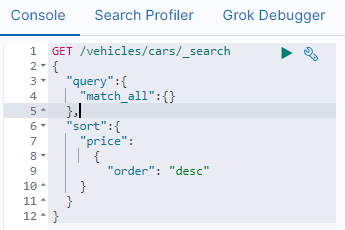
Matching documents:
| ID | Make | Model | Price | Color |
|---|---|---|---|---|
| 10 | BMW | X1 | 52000 | black |
| 9 | Ford | Endeavour | 44000 | grey |
| 3 | Toyota | Fortuner | 41000 | white |
Sort on a number, a date or a keyword field. Sorting on a text field fails by default, for the same reason that aggregations do. Use the keyword sub field, such as make.keyword.
Paging With from and size
The size setting sets how many hits come back, and the default is 10. The from setting skips that number of hits. Here are the hits from the fourth to the sixth, in price order:
Matching documents:
| ID | Make | Model | Price | Color |
|---|---|---|---|---|
| 2 | Toyota | Camry | 28000 | black |
| 6 | Honda | Civic | 26000 | black |
| 1 | Toyota | Corolla | 21000 | white |
Return Only Some Fields
The _source setting limits which fields appear in each hit. This keeps the response small.
Matching documents:
| ID | Make | Model | Price | Color |
|---|---|---|---|---|
| 3 | Toyota | Fortuner | 41000 | white |
| 9 | Ford | Endeavour | 44000 | grey |
| 10 | BMW | X1 | 52000 | black |
8. Bool Query: Must, Must_not and Should
The bool query joins other queries with logic. The old page listed three clauses, and then had filter in a separate section, with the list numbered 1, 2 and 1. In fact bool has four clauses. Here they are together:
| Clause | What it does | Scoring | Works like |
|---|---|---|---|
| must | The document must match | Adds to the score | AND |
| should | The document may match. A match adds to the score | Adds to the score | OR |
| filter | The document must match | Ignored, and can be cached | AND |
| must_not | The document must not match | Ignored, and can be cached | NOT |
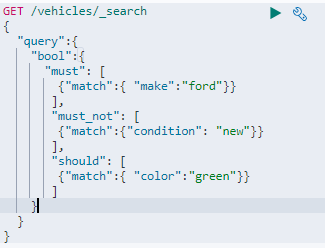
Here is one query that uses three of them. It looks for sedans, leaves out the black ones, and prefers Toyotas.
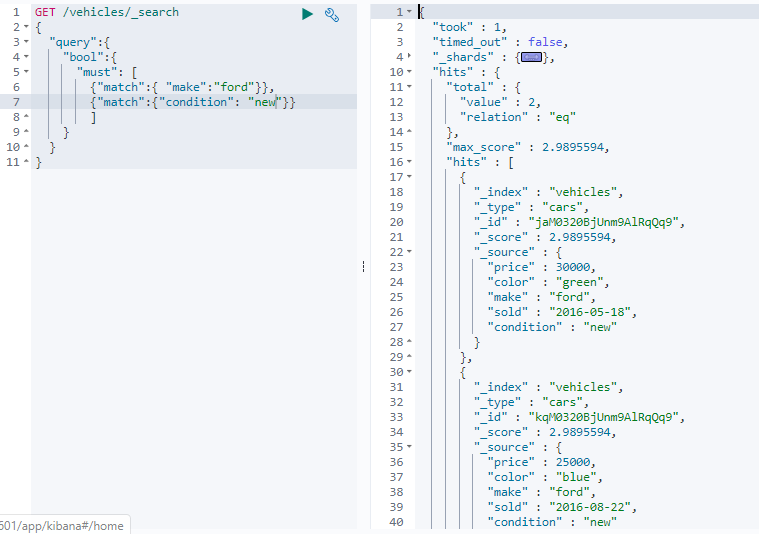
Matching documents:
| ID | Make | Model | Price | Color |
|---|---|---|---|---|
| 1 | Toyota | Corolla | 21000 | white |
| 5 | Honda | City | 19000 | silver |
| 7 | Honda | Amaze | 12000 | white |
Corolla matches the should clause too, so it gets the highest score and comes first. The order of the other two depends on their scores.
Check this by hand. The sedans are cars 1, 2, 5, 6 and 7. Removing the black ones (2 and 6) leaves 1, 5 and 7.
A Note on minimum_should_match
The Elastic docs say that a should clause is optional when the query also has a must or a filter clause. If a bool query has only should clauses, at least one of them must match, because the default value of minimum_should_match is then 1. Otherwise, the default is 0. Here the query has only should clauses, so a car must be white or silver:
Matching documents:
| ID | Make | Model | Price | Color |
|---|---|---|---|---|
| 1 | Toyota | Corolla | 21000 | white |
| 3 | Toyota | Fortuner | 41000 | white |
| 4 | Toyota | Yaris | 14000 | silver |
| 5 | Honda | City | 19000 | silver |
| 7 | Honda | Amaze | 12000 | white |
| 8 | Ford | Figo | 11000 | white |
9. Filter Query
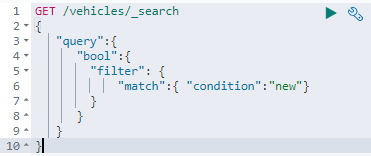
A filter requires a match, like must, but it does not change the score, and Elasticsearch can cache it. It is the right choice for exact values, such as a color, a status or a price limit. Here is a query for white cars that cost 20000 or less.
Matching documents:
| ID | Make | Model | Price | Color |
|---|---|---|---|---|
| 7 | Honda | Amaze | 12000 | white |
| 8 | Ford | Figo | 11000 | white |
Every hit has a score of 0, because a filter does not score.
The old page said that filter clauses are faster than any other component. That is too strong. The Elastic docs say that frequently used filters are cached, and that filter and must_not run without scoring. This often helps, but how much depends on your data and your cluster. Test on your own data before you claim a speed up.
Filter and Must Together
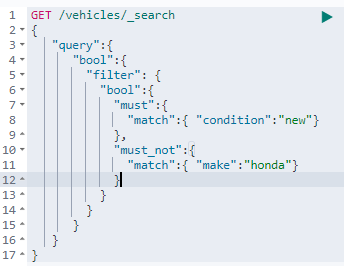
The most useful pattern is to put the search words in must, so that they score, and the exact conditions in filter. Here we look for sedans that cost 20000 or less:
Matching documents:
| ID | Make | Model | Price | Color |
|---|---|---|---|---|
| 5 | Honda | City | 19000 | silver |
| 7 | Honda | Amaze | 12000 | white |
constant_score
When you want a filter on its own, with the same score for every hit, wrap it in constant_score. The Elastic docs say this gives every match a score of 1.0.
Matching documents:
| ID | Make | Model | Price | Color |
|---|---|---|---|---|
| 2 | Toyota | Camry | 28000 | black |
| 6 | Honda | Civic | 26000 | black |
| 10 | BMW | X1 | 52000 | black |
Every hit has the same score of 1.0.
A Common Mistake: Term Query on a Text Field
The term query looks for the exact value that you type, and does not change it. A text field stores words in lower case. So if you search the make field for Ford with a capital F, nothing matches:
Matching documents: none.
Zero hits. The text field stores the lower case word ford, and a term query does not change the case of what you type.
For an exact match on a name, use the keyword sub field, which stores the value as it is:
Matching documents:
| ID | Make | Model | Price | Color |
|---|---|---|---|---|
| 8 | Ford | Figo | 11000 | white |
| 9 | Ford | Endeavour | 44000 | grey |
The rule is easy. Use match on text fields, and term on keyword fields, numbers and dates.
Which Query Should You Use?
| You want to | Use |
|---|---|
| Get every document | match_all |
| Search words in a text field | match |
| Search the same words in several fields | multi_match |
| Find words together, in order | match_phrase |
| Find an exact value, such as a color or a code | term on a keyword field |
| Find documents that have a field | exists |
| Find numbers or dates between limits | range |
| Join conditions with and, or and not | bool |
| Narrow results without changing the score | filter inside bool |
Common Query DSL Errors and How to Fix Them
| Problem | Usual cause | Fix |
|---|---|---|
| A term query finds nothing | The field is text, and the value has capital letters | Use the keyword sub field, or use match |
| Only 10 hits come back | The default size is 10 | Set size, or use from and size for pages |
| The result order looks random | No sort was given, so hits follow the score | Add a sort |
| A sort on a text field fails | Text fields are not meant for sorting | Sort on the keyword sub field |
| A should clause does nothing | The query also has a must or filter, so should is optional | Use minimum_should_match, or move it to must |
| The exists query misses a document | The value is null or an empty list | Remember that null counts as missing |
| The JSON request is rejected | A missing comma, or a curly quote copied from a web page | Check the commas, and use straight quotes |
Practice Exercises
- Create the cars index, and find all cars made by Honda with a match query.
- Find the cars that have the words compact and sedan together, in that order, with
match_phrase. - Find cars from 2022 or later, that cost less than 30000, using a range query on each field inside a bool filter.
- Sort all cars by year in descending order, and then by price in ascending order.
- Write a bool query that must match the word turbo in the description, must not be black, and should prefer a sunroof.
Once these nine queries feel natural, you can build almost any search from them. Start with a match for the words, add a filter for the exact conditions, and add a sort. Then look at aggregations, which summarise the same results into counts and averages. A good next step is to run these requests in Kibana Dev Tools against your own index, and change one thing at a time.
