Donut Chart
Donut Chart in Power BI
A donut chart shows how a set of categories add up to a whole, the same idea as a pie chart, but with a hollow center instead of a solid circle. It works best when you are comparing 2 to 4 categories. Add more than that and the slices get too thin to read, so a bar chart usually tells the story better once your category count grows.
This guide assumes you already have a dataset loaded in Power BI Desktop. If you have not done that yet, start with the Loading Datasets in Power BI Desktop guide first, then come back here.
Step by Step Process of Creating Donut Chart
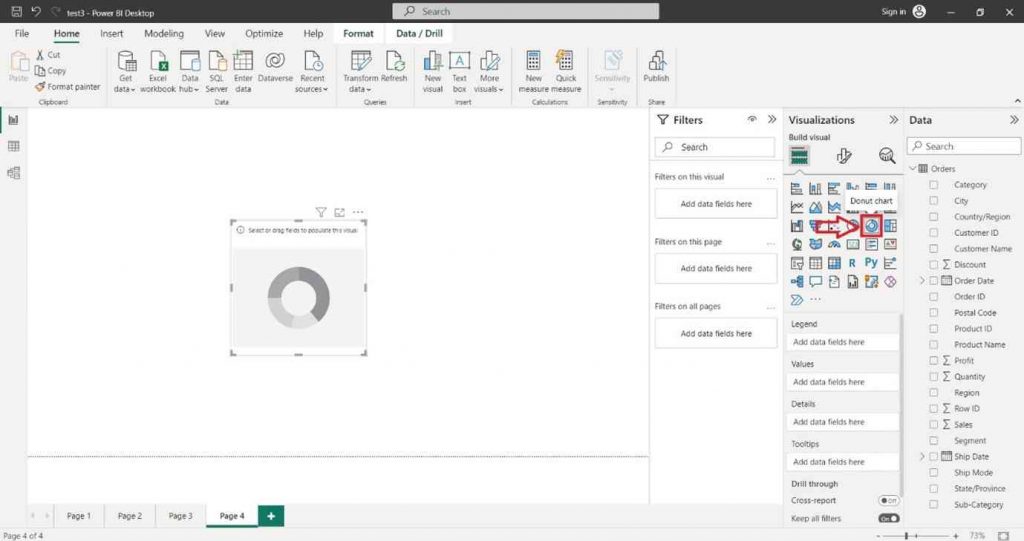
Step 1: Add a Donut Chart to the Report
In the Visualizations pane on the right, click the Donut Chart icon. This adds an empty donut chart visual to the report canvas, ready for your fields.
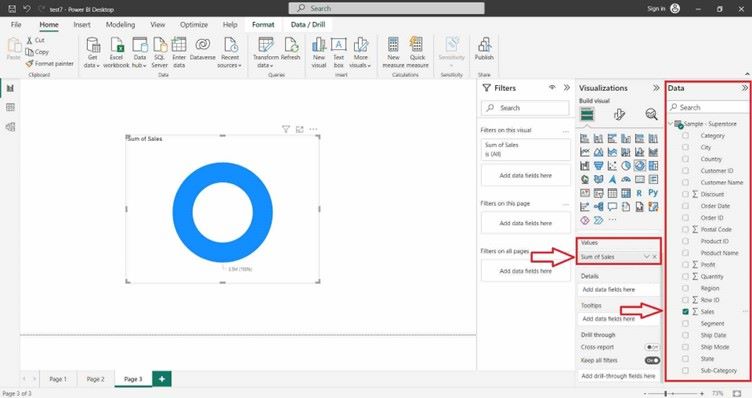
Step 2: Add a Field to Values
Still in the Visualizations pane, find the field you want to measure, such as sales or a count of records, and drag it into the Values section. This is what the donut chart will actually size its slices by.
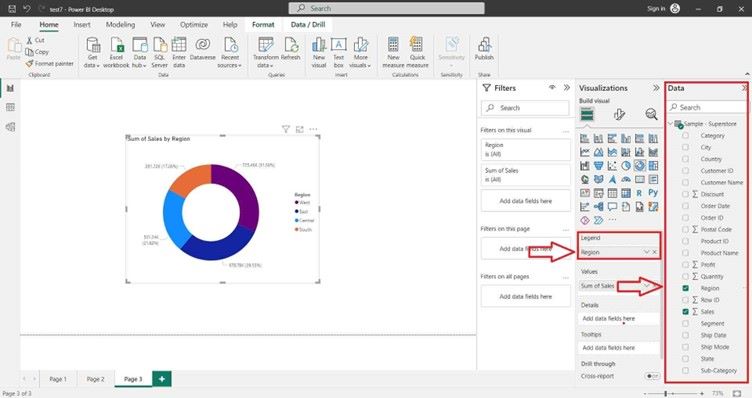
Step 3: Add a Field to Legend
Drag the field you want to split your data by, for example product category or region, into the Legend section. This is the step that turns one plain circle into separate colored slices, one per category.
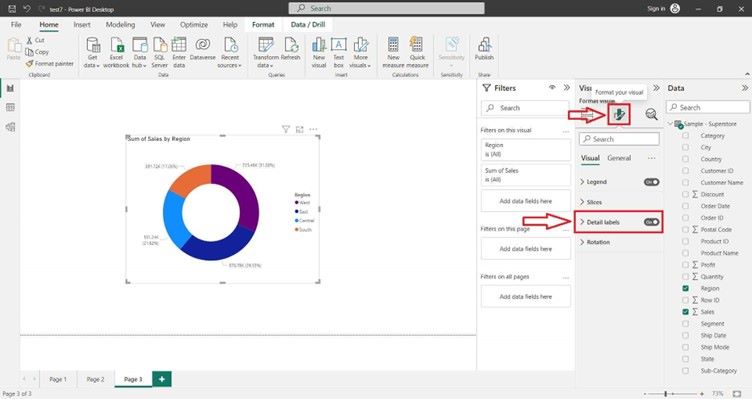
Step 4: Format the Chart and Turn On Data Labels
Click the Format icon (it looks like a paint roller) to open the Format pane on the right. Look for Data Labels and switch it on. This prints the value or percentage directly on each slice, so anyone reading the report can see the numbers at a glance instead of hovering over the chart.
Optional: Show a Total in the Center
One thing that sets a donut chart apart from a pie chart is that empty middle, and Power BI lets you use it. In the Format pane, under the Visual tab, turn on Center value. Power BI will display the sum of your values right in the center of the ring. From there you can control the number format, choose thousands or millions as display units, change the font, and even add a short label above or below the number, for example “Total Sales” instead of the field name.
More Ways to Format Your Donut Chart
- Value or percentage in the labels: in the Data Labels section of the Format pane, you can choose whether each slice shows its raw value, its percentage of the whole, or both. Percentage tends to read faster when you want people to grasp the split at a glance.
- Inner radius: under Slices in the Format pane, you can adjust how thick or thin the ring is. A thinner ring leaves more empty space in the center, which is useful if you are also displaying a center value or a card behind the chart.
- Consistent colors: if the same categories appear in other charts on your report, such as a bar chart or a table, set matching colors for each category so readers do not have to relearn the color key on every visual.
Donut Chart Compared to Pie Chart
Both charts plot the same kind of data and both work off Values and Legend fields the same way, so switching between them is mostly a style choice. The donut’s hollow center gives you somewhere to put a total or a short label, which a pie chart does not have room for. A donut also tends to look cleaner once you get to 3 or 4 categories, since the ring shape reads a little easier than a full circle of narrow wedges. A plain pie chart is still a fine choice when you only have 2 categories and do not need anything shown in the middle.
Common Mistakes to Avoid
- Using it for too many categories. Past 4 or 5 slices, a donut chart gets hard to read. Switch to a bar chart once that happens.
- Leaving data labels off when exact numbers matter. A donut chart is good at showing proportions at a glance, but if your audience needs the actual figures, turn labels on rather than making them hover over each slice.
- Letting colors drift across the report. If Product A is blue in one chart and green in another, readers lose the thread. Keep category colors fixed across every visual that uses them.
Rounding percentages too early. If your slice percentages are close to each other, add a decimal place to the data labels so the values do not visually contradict the numbers underneath.
That covers building, formatting, and choosing a donut chart in Power BI. To keep building out your report with other chart types, explore Prwatech’s Power BI training program, which includes placement assistance.