Funnel Chart
Funnel Chart in Power BI
A funnel chart shows how a value shrinks as it moves through a sequence of stages. It gets its name from its shape, wide at the top, narrow at the bottom, and it is built to answer one specific question. Out of everyone who started this process, how many made it through each stage, and where did the rest drop off.
This is why it shows up so often for sales pipelines, marketing funnels, and website conversion journeys. Anywhere a process moves people or items through a fixed set of steps, and the count naturally shrinks at each step, a funnel chart is the right shape for the story.
What Your Data Needs Before You Build One
A funnel chart needs two things at minimum from your dataset:
- A category field, the stages themselves, such as leads, contacted, demo scheduled, proposal sent, and closed won.
- A numeric value field, the count or amount at each stage, such as number of deals or number of visitors.
One thing worth knowing before you start. Power BI sorts the stages by value from largest to smallest by default, not by whatever row order they sit in inside your table. If your stages need to appear in a specific logical order rather than strictly by size, you will need to set that sort order yourself once the chart is built.
Step by Step Process of Creating Funnel Chart
Step 1: Add a Funnel Chart to the Report
In the Visualizations pane, click the Funnel Chart icon. This adds an empty funnel chart visual to the report canvas.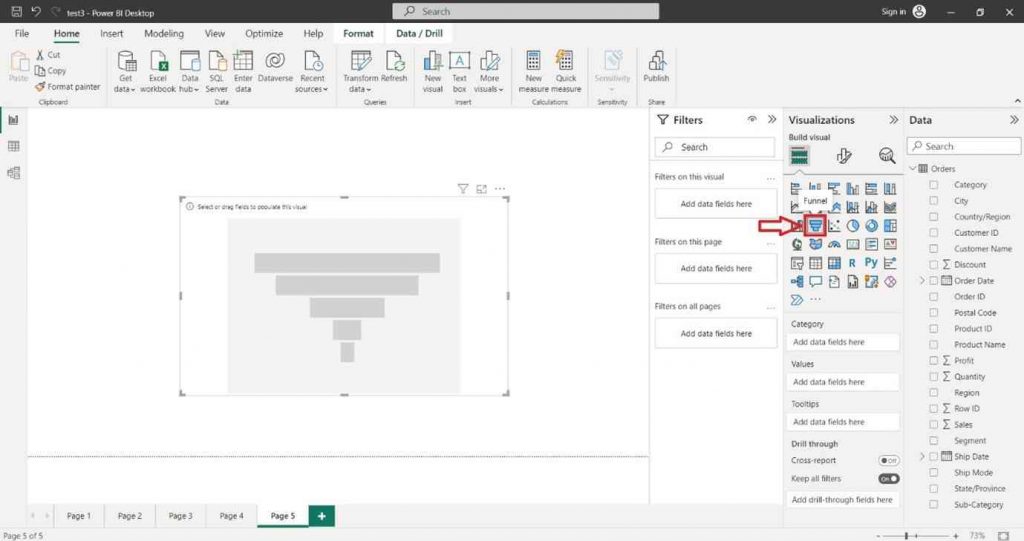
Step 2: Add a Field to Category
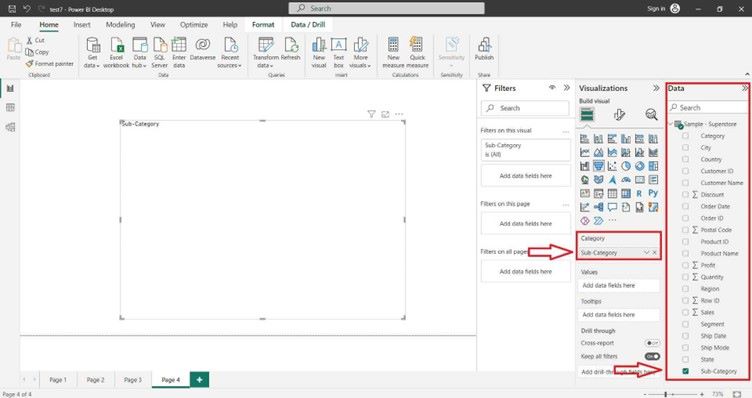
In the Visualizations pane, drag the field that represents your stages into the Category section.
Step 3: Add a Field to Values
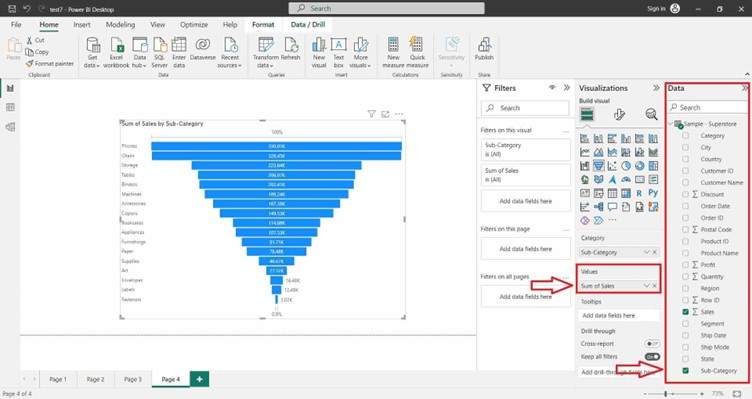
Drag the number you want to measure at each stage, such as count or amount, into the Values section. This is what decides the width of each stage in the funnel.
Step 4: Format the Chart and Turn On Data Labels
Click the Format icon to open the Format pane. Look for Data Labels and switch it on. This prints the value for each stage directly on the chart.
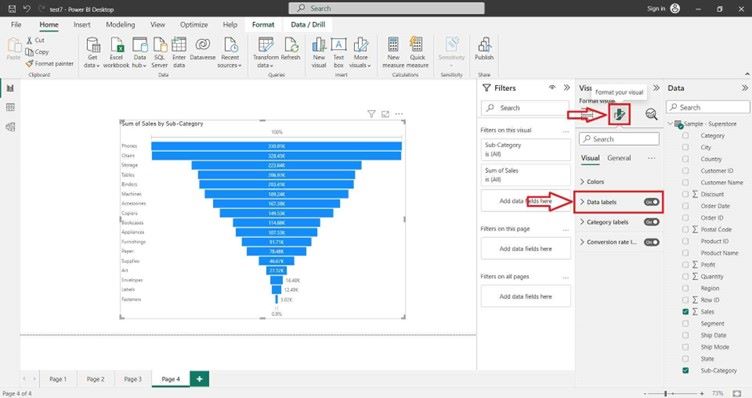
Choosing the Right Data Labels for Conversion Rates
A funnel chart earns its keep once you get past raw values and start showing conversion, and this is the part the default settings do not do for you automatically. In the Format pane, under Data Labels, open the Label contents dropdown for two useful options alongside the plain data value.
- Percent of first, which shows each stage as a percentage of the very first stage. This is the number to use when you want the overall conversion rate from start to finish, for example what percentage of total leads eventually closed.
- Percent of previous, which shows each stage as a percentage of the stage right before it. This is the number to use when you want to find exactly where the biggest drop happens between two specific steps.
There is also a separate Conversion rate labels toggle in the Format pane, which prints the percentage directly on the connectors between stages rather than inside the stage itself, making a sudden drop visually obvious without reading a single number.
When to Use a Funnel Chart
- Your data represents a sequence of stages where the value naturally decreases at each step, such as a sales pipeline or a signup flow.
- You want to see where people or items drop off, not just the final total.
- You have at least 4 stages. Fewer than that and a simple bar chart or a pair of numbers usually communicates the same thing with less visual overhead.
Common Mistakes to Avoid
- Too many stages. Once you pass around 6 or 7 stages, the funnel gets visually cramped and hard to read. Group minor steps together or split a very long process into two funnels.
- Data that does not actually decrease. A funnel chart assumes each stage is a subset of the one before it. If a later stage has a higher value than an earlier one, the shape breaks and the chart stops making visual sense.
- Leaving the sort order to default. Since Power BI sorts by value automatically, always check the sort order once your chart is built, especially if your stages need to appear in a specific logical sequence rather than strictly by size.
- Never enabling Percent of first or Percent of previous. A funnel chart with only raw values on it makes people do the conversion math themselves. The whole value of this chart type is in the percentages.
That covers building, formatting, and reading a funnel chart in Power BI. To keep building out your report with other chart types, explore Prwatech’s Power BI training program, which includes placement assistance.