Creating Filestore instances
Creating a Filestore Instance in Google Cloud
Filestore is Google Cloud’s managed file storage. An instance is the file server, a file share is the directory it serves over NFS, and virtual machines mount that share and use it like a local folder, so several machines can work on the same files.
Creating one takes a few clicks, but three choices made here matter more than the rest. The service tier decides performance, availability, and whether you can ever make the instance smaller. The capacity decides your bill, because you pay for what you provision, whether or not you store anything on it. And the network decides which machines can reach the share at all. Billing also starts the moment the instance exists.
This walks through creating an instance in the console, with the tier comparison and the cost explained at the steps where you choose them.
Prerequisites
- A Google Cloud account with billing enabled. The Enabling Billing guide in this series covers that.
- A VPC network for the instance to live in, since clients must be in the same network. The Creating VPC Network guide in this series covers that.
Step by Step Process of Creating a Filestore Instance
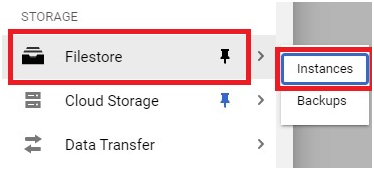
Step 1: Open Filestore Instances
Open the console, then open Menu > Filestore > Instances
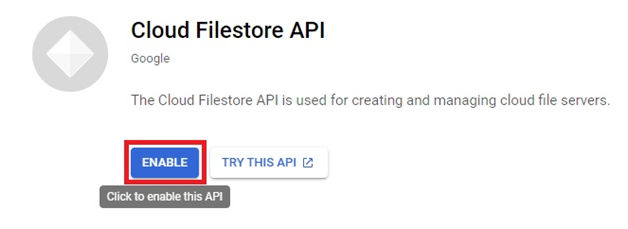
Step 2: Enable the API
Click Enable to turn on the Filestore API. The original page called this the Firestore API, which is a different product.
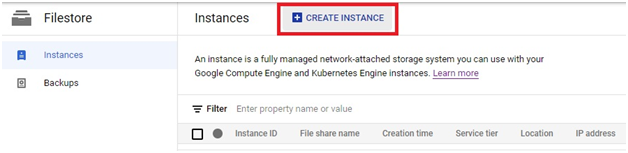
Step 3: Create an Instance
Click Create instance.
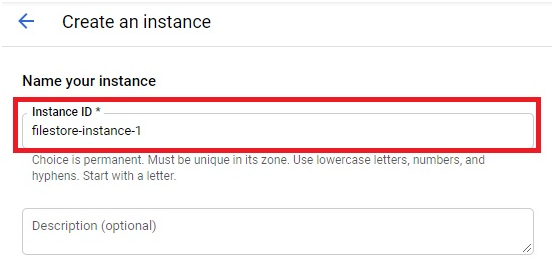
Step 4: Give the Instance an ID
Enter an instance ID.
Step 5: Compare the Service Tiers
Choose the service tier for your needs. Click Compare instance types to see the options side by side.
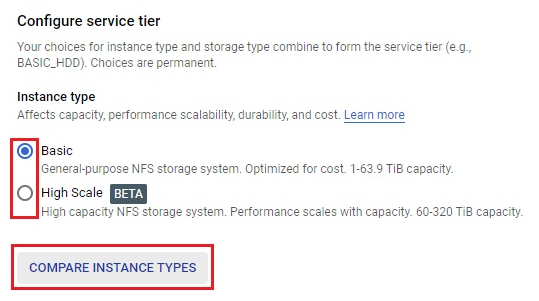
The Current Service Tiers
|
Service tier |
Capacity range |
Availability |
Scaling |
|
Basic HDD |
1 TiB to 63.9 TiB |
Zonal |
Up only |
|
Basic SSD |
2.5 TiB to 63.9 TiB |
Zonal |
Up only |
|
Zonal |
1 TiB to 100 TiB |
Zonal |
Up or down |
|
Regional |
1 TiB to 100 TiB, or from 100 GiB where small capacity instances are available |
Regional |
Up or down |
|
Enterprise |
1 TiB to 10 TiB |
Regional |
Up or down |
Basic HDD and Basic SSD were formerly called Standard and Premium. Zonal was formerly called High Scale SSD. The two Basic tiers can only grow after creation, while Zonal, Regional, and Enterprise can be scaled up or down within their limits. The Editing a Filestore Instance guide in this series covers that. If you are unsure which tier to pick for learning, remember that a bigger minimum capacity means a bigger monthly bill.
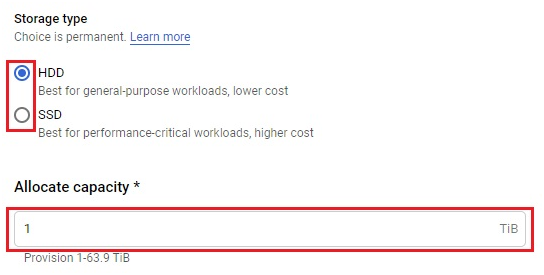
Step 6: Choose the Tier and the Capacity
Choose the type of storage you want and its capacity. The original page says capacity starts from TB, but as the table shows, the minimum depends on the tier. Capacity is measured in TiB and GiB, which are slightly larger than TB and GB.
Step 7: Check the Cost Estimate
Look at the right side of the screen for the cost estimate before you continue.
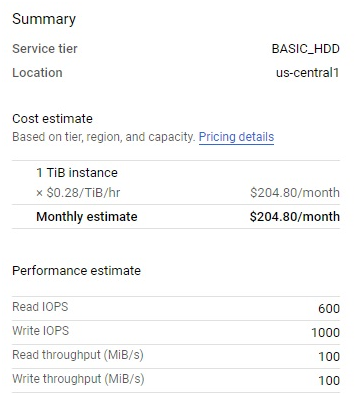
What a Filestore Instance Costs
Google’s pricing page says you are charged for the provisioned capacity, not the capacity used. A mostly empty instance costs the same as a full one. Prices vary by region and tier, so treat these as illustrations and check the pricing page for your own numbers.
|
Example |
Capacity |
Approximate monthly cost |
|
Basic HDD at 0.16 US dollars per GiB per month, the rate in Google’s own Oregon example, at the 1 TiB minimum |
1,024 GiB |
About 163.84 US dollars |
|
Basic HDD at the same rate, Google’s own 2 TiB example |
2,048 GiB |
327.68 US dollars |
|
Basic SSD in Iowa at 0.000410959 US dollars per GiB per hour, about 0.30 per GiB per month, at the 2.5 TiB minimum |
2,560 GiB |
About 768 US dollars |
On the Zonal and Regional tiers with custom performance, the price has three parts, a fee per instance, a charge per GiB of capacity, and a charge for each IOPS you purchase. If you are on a free trial, note that a Basic SSD instance at its minimum size, at the rate above, would use up the 300 dollar credit in roughly twelve days. Delete practice instances as soon as you are finished with them.
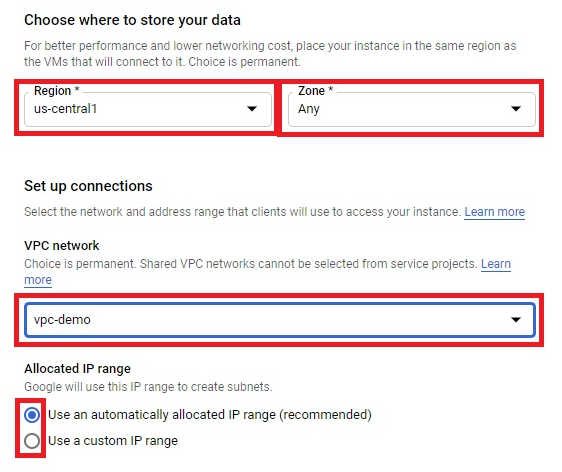
Step 8: Choose the Location and Network
Choose the region and zone, then the VPC network. Clients that will mount the share must be in the same project and VPC network. You can choose an automatic IP range, which lets Google Cloud choose it for you, or a custom range, which lets you choose it yourself, useful if you plan your network addresses carefully.
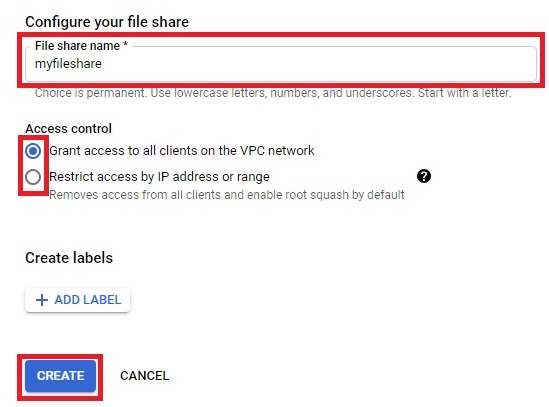
Step 9: Name the File Share and Set Access
Give the file share a name. The original page then tells you to grant access to all clients in the VPC network and click Create. That is the broadest option, since any machine in the network can mount the share. If only certain machines or address ranges need it, add narrower IP based access rules instead. Each rule combines an address range with an access mode and a squash mode, and the Editing a Filestore Instance guide in this series explains them.
Step 10: The Instance is Created
The Filestore instance is created.

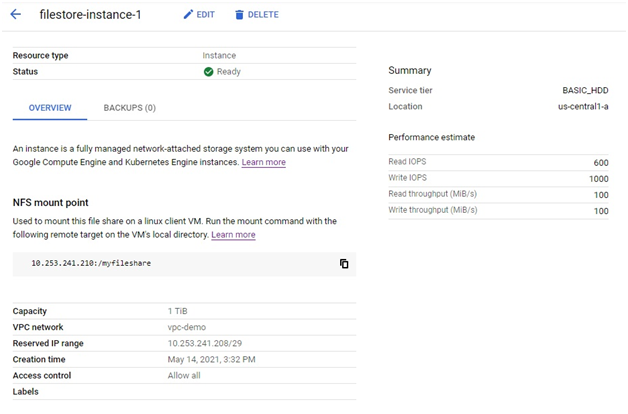
Step 11: View the Instance Details
Open the instance to see its details. Note the IP address and the file share name, since together they make up the NFS mount point the Mounting a Filestore File Share on Compute Engine Clients guide in this series asks for.
Common Mistakes to Avoid
- Enabling the Firestore API instead of the Filestore API. They are different products.
- Choosing a tier without checking its minimum capacity and what that costs each month.
- Assuming you are billed only for the data you store. You are billed for the capacity you provision.
- Picking a Basic tier and expecting to shrink it later. Those tiers can only grow.
- Leaving a practice instance running after you finish.
- Granting access to every client in the network when only a few machines need the share.
That covers creating a Filestore instance, and what the tier and capacity you choose will cost. To go further, explore Prwatech’s Google Cloud training program, which includes placement assistance.






